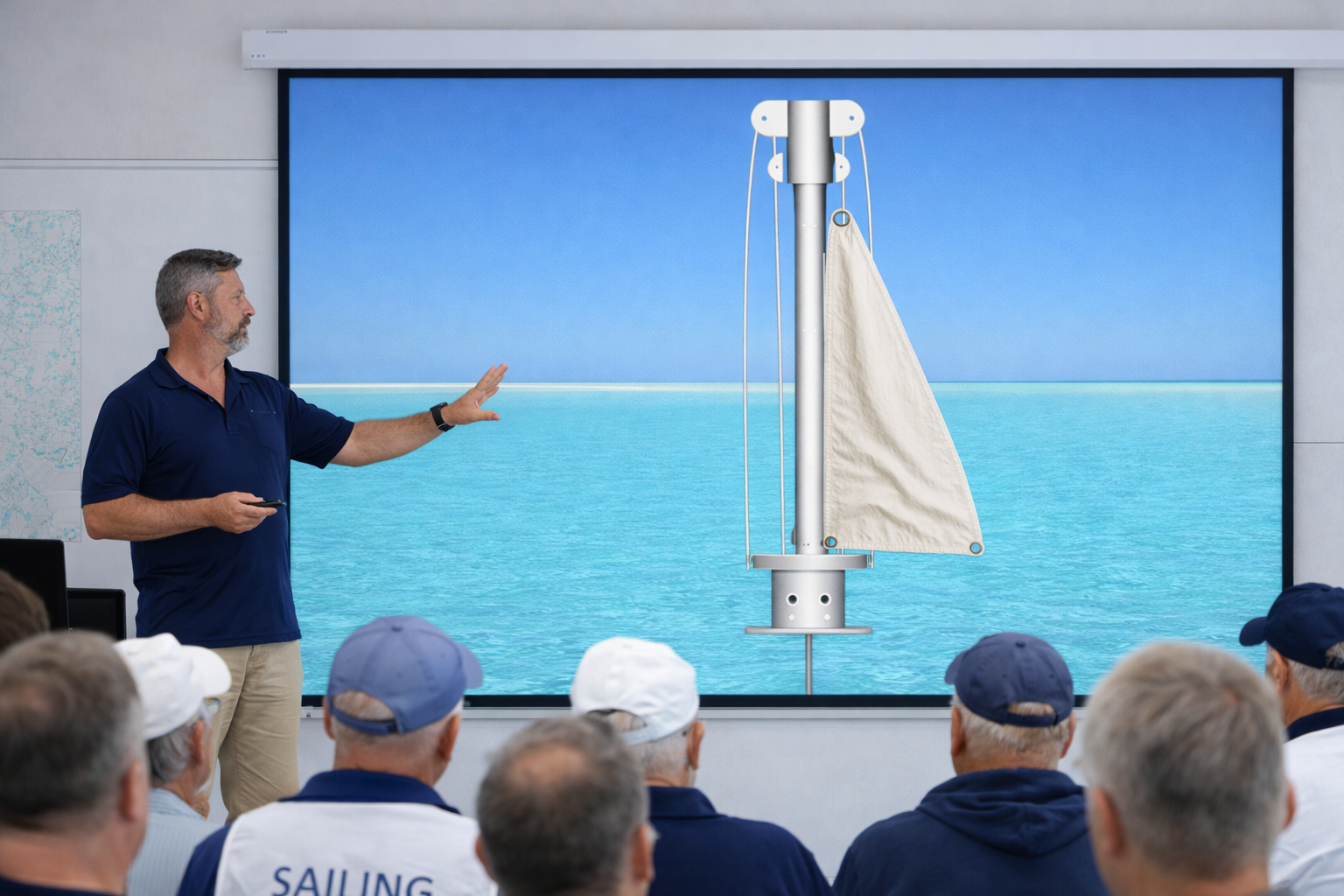
Roller Furlers & External Halyards
If you have ever fought halyard wrap at the headstay or priced out a furling install that required rigging removal, you already know where the usual systems start to work against you. A roller furling system with external halyards changes that equation by removing the swivel-dependent layout and replacing it with a simpler mechanical approach that can be installed from the deck.
For many sailboat owners, that matters more than one extra feature on a spec sheet. Less hardware aloft, fewer moving parts, and no dependence on the ship's jib halyard can solve real problems on recreational and performance boats alike. The result is not just easier furling. It is a cleaner system architecture.
What a roller furling system with external halyard actually changes
Most conventional furlers are built around an internal foil assembly, a halyard swivel, and bearings that must stay clean, aligned, and free-running. That design can work well, but it also creates familiar failure points. Halyard wrap, seized bearings, corrosion, added weight aloft, and labor-heavy installation are all part of the trade-off.
An external halyard design takes a different path. Instead of relying on the boat's jib halyard and a swivel at the top of the sail, the sail is raised and managed with external halyards built into the furling system concept. That removes one of the most common causes of poor furling performance - halyard lead angle problems that produce wrap at the top unit.
This is why the phrase no halyard wrap is not marketing fluff when the system is engineered around external halyards from the start. If there is no ship's jib halyard and no swivel in the load path, the geometry that causes wrap is not there to begin with.
Why external halyard systems appeal to hands-on boat owners
The strongest case for this type of furler is not novelty. It is mechanical efficiency. Boat owners who install and maintain their own systems tend to value designs that reduce service points and avoid specialized labor. An external halyard furler speaks directly to that mindset.
The first advantage is installation. A system that installs from the deck, whether the boat is in or out of the water, removes a major barrier for owners who do not want to schedule a yard visit or pay for mast climbing. That also lowers risk. Working from the deck is simply safer than sending someone aloft to retrofit a furler.
The second advantage is compatibility. Boats with existing rig setups, older spars, or limited clearance often do better with systems that do not demand a full rework of the headstay area. A modular design that wraps around the stay wire instead of forcing a complete rigging change makes retrofits more realistic.
The third advantage is maintenance. Bearings can seize. Aluminum can corrode. Long foil sections can be awkward to ship, store, and handle. A simpler split drum layout and shorter interlocking foil sections reduce those pain points.
The engineering trade-offs matter
Not every boat needs the same furling system, and that is where honest evaluation matters. Internal halyard systems have a long track record and are familiar to many sailors and riggers. On some boats, especially where a full headsail program is already built around conventional gear, staying with that layout may feel more straightforward.
But familiarity is not the same as efficiency. If your current concern is halyard wrap, installation complexity, or weight aloft, then a roller furling system for external halyard deserves a close look because it addresses those issues at the design level rather than trying to manage them after the fact.
There is also a difference between a system that merely avoids one problem and one that improves the whole installation experience. If a furler still requires cutting long foil sections, removing rigging, or climbing the mast, then one solved issue may come with three new ones. Good marine hardware should reduce complexity overall.
Material choice is not a side detail
A lot of furling buyers still assume metal automatically means stronger and better. That assumption does not always hold up once you look at where loads actually live in a furling system. Material performance depends on geometry, stress concentration, corrosion exposure, and weight distribution, not just tradition.
This is where advanced 3D manufacturing changes the conversation. Acrylonitrile-Styrene-Acrylate, or ASA, offers corrosion-free performance and lighter component weight, but the larger advantage is how the parts can be engineered. Focused infill strength can be built into high-stress areas in ways that are not feasible with extruded aluminum. That means strength can be placed where the loads are, instead of carrying extra material everywhere.
For sailors, the practical benefit is simple. Lighter parts are easier to handle during installation, and less weight aloft is generally a positive on small- to mid-size sailboats. Corrosion-free parts also reduce one more long-term maintenance concern in a marine environment.
Why short interlocking foils make sense
Long foil lengths are one of those accepted inconveniences that many sailors stop questioning until they have to transport, cut, or align them. Shorter foil sections change that experience significantly.
A system built around 12-inch foil sections that interlock every 6 inches increases torsional strength while making the package easier to ship and easier to work with on deck. That is not just about convenience. Torsional rigidity matters in furling because twist transfer is what lets the rolling action travel up the stay and actually furl the sail under load.
Short modular sections also eliminate the need for cutting in pre-sized packages. That reduces install error. Anyone who has worked through a retrofit knows that every field cut is another chance to get alignment, finish, or final length wrong.
Where a roller furling system with external halyards fits best
This type of system is especially attractive for coastal cruisers, trailer sailors, and owners of 22 foot - to 50-foot sailboats who want reliable headsail handling without turning the project into a rigging job. It also fits owners who value behind-the-mast and forestay flexibility and do not want a product locked into one narrow use case.
It can be a strong option for older boats being modernized on a budget, because labor savings can be as important as hardware cost. If you can install safely from the deck and avoid rigging removal, the total project cost looks very different.
For technically engaged sailors, the real value is that the system removes unnecessary dependencies. No swivel. No seized bearing concern. No ship's jib halyard requirement. Fewer moving parts often means fewer surprises.
What to evaluate before you buy
The best buying decision starts with fit, not claims. Measure your stay length carefully and think about your actual use case. Are you furling a working jib on a coastal cruiser, setting a light sail behind the mast, or retrofitting an older boat that has limited clearance and limited appetite for invasive installation work?
Also look at package logic. Pre-determined length packages can save time if the sizing is clearly defined. A modular system with a compact shipping footprint is easier to receive, store, and install than a crate full of long extrusions. That may sound secondary, but it affects the real ownership experience from day one.
Finally, evaluate whether the system solves your main problem directly. If halyard wrap has been your recurring issue, a better bearing is not the same as a design that removes the wrap condition entirely. If labor cost is the problem, a premium furler that still requires mast work may not be the better value.
3DFurler approaches this from the standpoint that furling should be mechanically simpler, lighter, and easier to install without giving up strength where it counts.
A good furler should make the boat easier to sail, not more complicated to own. If an external halyard design gives you cleaner mechanics, safer installation, and fewer failure points, that is not a niche advantage. That is smart engineering doing its job.