Roller Furler Sizing Guide for Better Fit
A roller furler that is an inch wrong on paper can turn into a system that binds, sags, or forces workarounds at the dock. That is why a proper roller furler sizing guide starts with the stay and the sail plan, not the catalog. If you size the unit around the actual geometry of the boat, the install is cleaner, furling is smoother, and you avoid solving one rigging problem by creating another.
Most sizing mistakes happen for a simple reason. Owners measure what is easy to reach instead of what controls the system. A drum diameter, a foil section, or the boat's advertised length tells you very little by itself. What matters is the usable length along the forestay or aft stay position, the sail's luff relationship to that stay, and the hardware clearances at both ends.
What a roller furler sizing guide should actually measure
The first number that matters is stay length. Not boat length. Not mast height from a brochure. Not sail size in square feet. The furler package has to match the wire it wraps around, because that wire defines the working spine of the system.
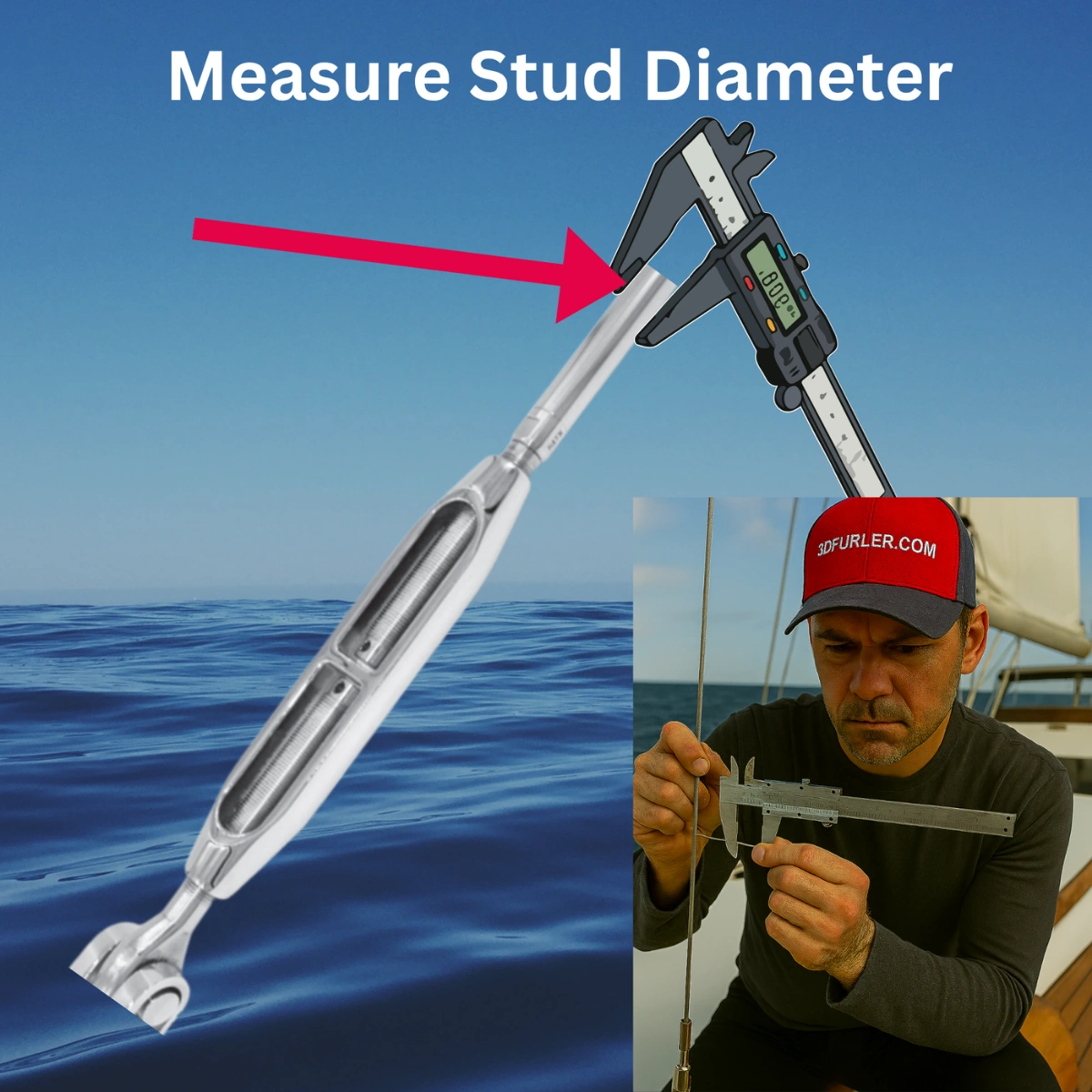
If you are measuring a headsail furler on a forestay, measure the full stay run between attachment points as installed on the boat. If you are sizing a system for a behind-the-mast application, the same principle applies. Measure the actual wire path that the foil sections and drum assembly will use. The safest approach is to work from the installed rig rather than from original drawings, especially on older boats where toggles, turnbuckles, mast steps, or deck fittings may have changed over time.
The second number is clearance. A furler does not live in a vacuum. It needs room at the tack end for the drum and room at the head end for proper termination and sail travel. If the lower unit crowds the deck, anchor hardware, pulpit, or stem fitting, operation suffers. If the upper end conflicts with existing fittings or the sail head geometry, furling tension and alignment can suffer.
The third factor is sail relationship. Your sail's luff length needs to work with the stay length and the furling configuration. Too much mismatch and you end up with poor tack height, wasted luff length, or compromised sail shape. A sizing guide that ignores the sail will get you physically close but not functionally right.
How to measure for roller furler sizing without guesswork
Start with the stay itself. Measure pin-to-pin where possible, or from the centerline of one attachment point to the centerline of the other. If you cannot measure pin-to-pin directly, measure the installed span carefully and note every fitting included in that stack. Small errors add up fast in rigging.
Next, look at the lower end. Measure from the lower stay attachment up to the point where the drum can sit and rotate freely. This is where deck geometry matters. Bow pulpits, anchor rollers, deck chocks, and furling line lead angles can all change what "fits" in the real world.
Then check the top end. You need to know how much room exists for the upper foil termination and whether the sail head setup will clear it. On some boats, the difference between a clean installation and an awkward one is a matter of inches at the masthead or upper stay fitting.
A good rule is to record more than one dimension and annotate it. Write down stay length, lower clearance, upper clearance, and current sail luff length. A single bare number without context is how wrong parts get ordered.
Why boat length is a poor sizing shortcut
Owners often ask whether a 28-foot boat needs the same package as another 28-footer. Sometimes yes, often no. Two boats with the same LOA can have different rig heights, different stem fittings, different rake, and different stay lengths.
That is why pre-determined package lengths work best when they are based on actual measured stay range rather than a generic boat class. A system sized in measured increments is more useful than one sized by marketing category because rig geometry does not care what the brochure called the boat.
Matching package length to real-world installation
This is where practical engineering matters. A furler system should not force cutting, machining, or a stack of improvisations just to fit a common sailboat. If the system is offered in a broad range of pre-determined lengths, you can match the measured stay length more directly and avoid unnecessary modification.
That matters for more than convenience. Every field cut introduces the chance for measurement drift, uneven assembly, or compromised fit. A package selected to the correct length from the start reduces install variables and makes deck-level installation much more straightforward.
For DIY owners, that is a major difference. The less the system depends on custom trimming and rig removal, the more likely the installation stays accurate, safe, and repeatable.
Roller furler sizing guide trade-offs that owners should know
Bigger is not automatically better. An oversized system can add unnecessary weight and bulk, especially where it affects handling and sail balance. On smaller boats, excess hardware is not just inefficient. It can alter line routing, tack height, and deck access.
Smaller is not safer either. Undersizing can show up as torsional weakness, reduced durability under load, or poor long-term behavior when the sail is partially furled. A furling system works under repeated twist loads, shock loads, and environmental exposure. Proper sizing has to respect structure as much as fit.
Material choice also affects the sizing conversation. Traditional aluminum systems often carry assumptions about stiffness and section length that do not translate directly to newer manufacturing methods. A lighter, corrosion-free material package may reduce weight and simplify handling, but the real question is how strength is engineered into the load path. Focused reinforcement in stress-prone areas can outperform generic bulk if the design is done correctly.
That is where short, interlocking foil sections have an advantage worth understanding. A modular foil design can ship compactly, install more easily, and still maintain torsional strength if the interlock geometry is doing real work instead of just joining pieces together.
Sizing is also about what problems you are trying to eliminate
Some owners are replacing an older furler because of bearing seizure, halyard wrap, or difficult service access. In those cases, the right size alone does not solve the whole problem. The architecture of the system matters.
For example, a design that avoids a jib halyard swivel and uses external halyards changes the failure profile significantly. Likewise, a drum clamp-on approach without axial bearings removes one of the common maintenance headaches found in older assemblies. When you are choosing size, it makes sense to evaluate whether the system design also eliminates the issue that pushed you to replace the old hardware in the first place.
Common sizing errors in a roller furler sizing guide
The most common error is measuring the sail and assuming the hardware can be made to match. The stay comes first. The sail can often be adjusted, recut, or selected around the stay geometry. The furler cannot ignore the wire it is built around.
The next error is forgetting installed hardware height. Turnbuckles, toggles, shackles, and stem fittings all consume space. If your measurement skips those details, the selected package may be technically close but practically wrong.
Another frequent problem is assuming the mast must come down for accurate sizing. It does not. In many cases, a well-designed system can be measured and installed from the deck, in or out of the water, which removes a major barrier for owners trying to avoid rigging labor and mast-climbing risk.
The last mistake is treating all furlers as equivalent once length is matched. Length is only one part of the fit. Drum layout, foil connection method, line path, upper termination, and sail interface all affect whether the system works cleanly after installation.
When to ask for help before you order
If your boat has been modified, if your stay fittings are non-standard, or if you are converting from an older furling setup with unusual hardware, get a second set of eyes on the dimensions. This is especially true on older coastal cruisers and custom-rigged boats where decades of owner changes may not match original factory specs.
It also helps to ask questions if you are between package lengths. In that situation, the right answer depends on where the tolerance lands, what lower and upper clearance you have available, and how the sail is going to be set up. A mechanically credible supplier should be willing to talk through those variables instead of pushing a one-size-fits-all answer.
One reason some owners choose 3DFurler.com is that the package logic is built around measured fit, simplified installation, and compatibility across a wide range of sailboats. That approach makes sizing more practical because it starts with actual rig dimensions, not assumptions.
The simplest path to the right fit
If you want your furler to install cleanly and work the way it should, measure the stay, check both end clearances, and compare that to the real sail setup you plan to use. Ignore brochure shortcuts. Ignore boat-length guesses. The system should match the wire path and operating geometry of your boat.
A good furling setup should reduce complications, not introduce new ones. When the size is right, everything downstream gets easier - installation, sail handling, line management, and long-term reliability. Take the extra few minutes to measure like a mechanic, not like a shopper.