Myth: “Integral Halyards Cause Side‑Loading”

Some sailors have circulated the idea that integral‑halyard furling systems place harmful side‑loads on the forestay
Others have echoed this concern in passing, suggesting these systems may not be ideal for “rigorous offshore work.”
The physics of sail loading, show a very different picture
The misconception usually goes like this:
Because the furler contains its own halyard, the sail luff is not tensioned from the masthead, so the forestay receives lateral load that would otherwise be relieved by the halyard
This sounds plausible—until you look at how sail forces actually travel through a rig
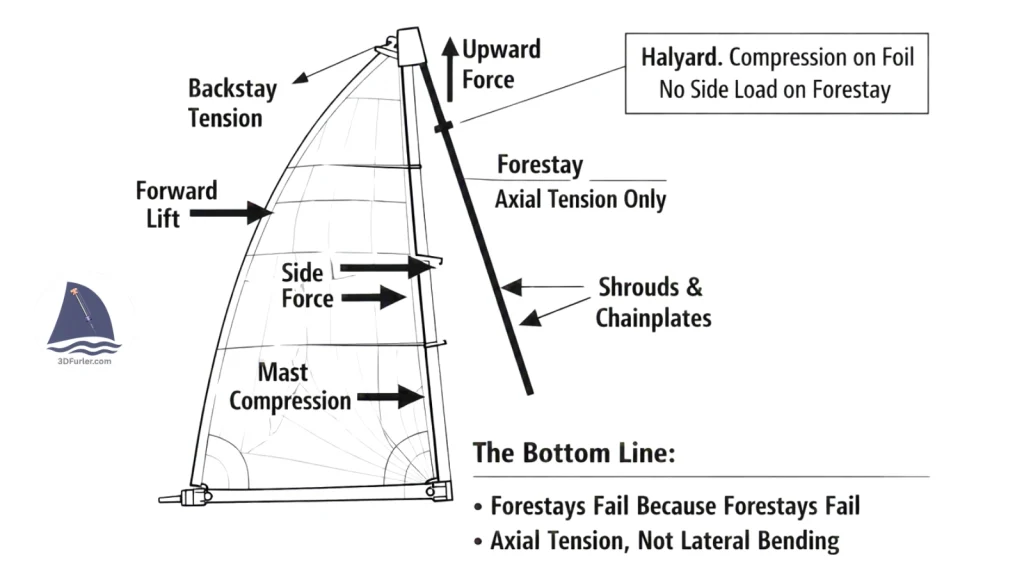
How a Powered‑Up Head Sail Really Loads the Rig
When a jib or genoa is under way, it generates aerodynamic lift. That lift has forward, sideways, and vertical components
But here’s the critical point:
The forestay sees almost entirely axial tension, not lateral bending
Why?
- The sail’s luff tension loads the foil in compression; only a minor lateral component transfers into the forestay.
- The sideways component is resolved by **backstay tension, mast compression, shrouds, and chainplates.
- The halyard—whether masthead or integral—”does not carry forestay side‑load”. It tensions the sail with a compression load on the foils and NOT the stay.
The Bottom Line
Forestays fail because forestays fail
Not because of the furler
Not because of the sail
Not because of the halyard design
The engineering is clear:
Integral‑halyard furlers do not impose harmful side‑loads
Sail pressure produces axial tension , not terminal bending
Terminal failures match fatigue and corrosion, not furler mechanics
Offshore capability is determined by rig integrity , not furler style
Non‑technical opinions may circulate, but the physics
and decades of offshore use—tell the real story
Questions about your rig?
Technical calls go straight to someone who has fitted these. Have your stay length and wire size ready and we can size it on the phone. 904-600-4105 or help@3dfurler.com.